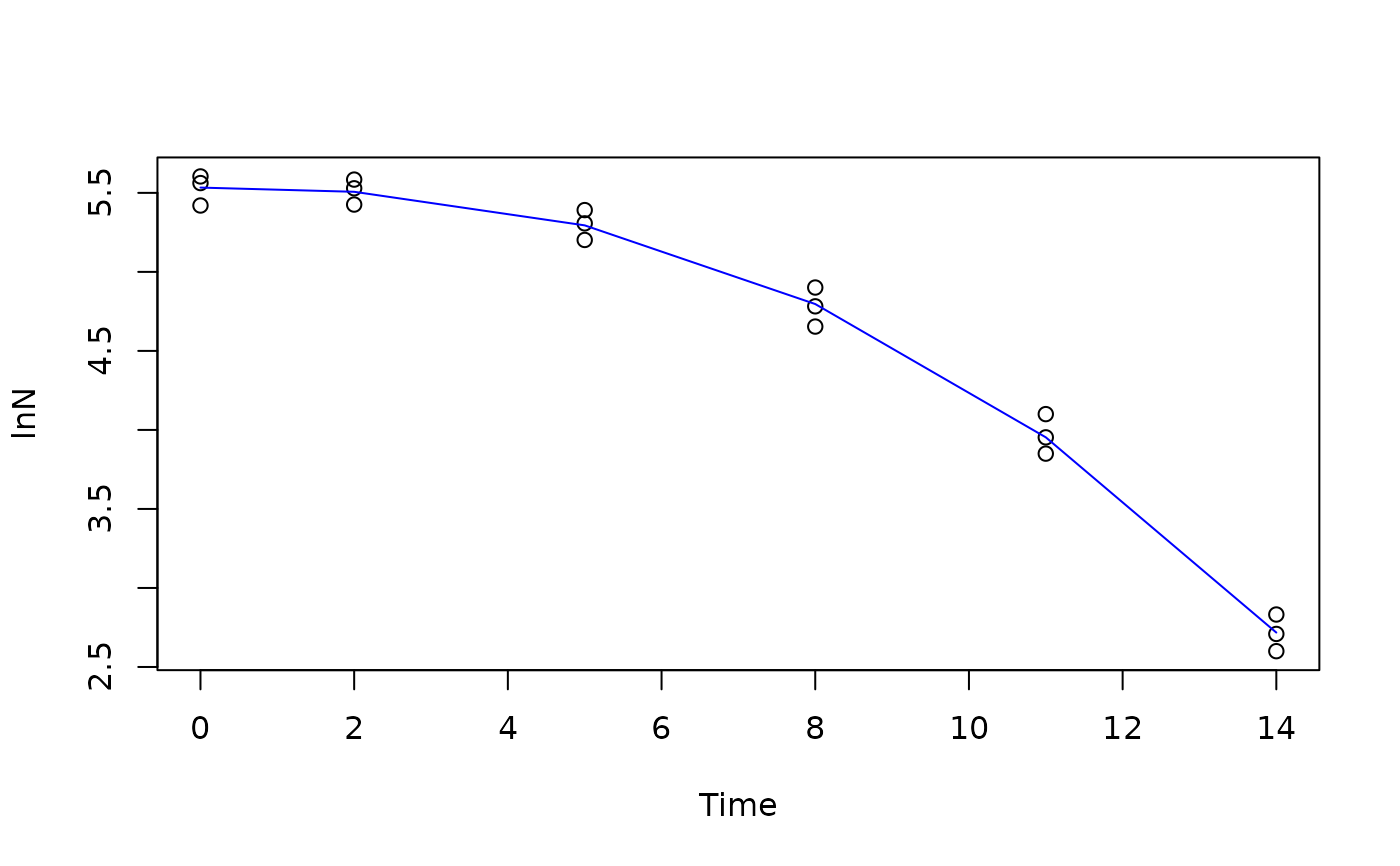
Weibull inactivation model Peleg and Huang
Source:R/weibull_inactivation_peleg_huang.R
WeibullPH.RdWeibullPH inactivation model for microbial inactivation curve.
Returns the model parameters estimated according to data collected in microbial inactivation experiments.
Details
The model's inputs are:
t: time, assuming time zero as the beginning of the experiment.
Y(t): the natural logarithm of the bacterial concentration X(t) measured at time t.
Users should make sure that the bacterial concentration input is entered in natural logarithm, Y(t) = ln(X(t)).
The following parameters can be estimated using Weibull function:
t: is heating time under a constant temperature
Y0: is the initial (time=0) bacterial counts in natural logarithm of the initial bacterial counts;
k: is the inactivation rate (ln units/time)
alpha: is the shape parameter of the survival curve
References
Huang L (2009). “Thermal inactivation of Listeria monocytogenes in ground beef under isothermal and dynamic temperature conditions.” Journal of Food Engineering, 90(3), 380-387. ISSN 0260-8774, doi:10.1016/j.jfoodeng.2008.07.011 .
Author
Vasco Cadavez vcadavez@ipb.pt and Ursula Gonzales-Barron ubarron@ipb.pt
Examples
library(gslnls)
data(bixina)
initial_values <- list(Y0 = 6.0, k = 1.0, alpha = 0.2)
fit <- gsl_nls(lnN ~ WeibullPH(Time, Y0, k, alpha),
  data = bixina,
  start = initial_values
)
summary(fit)
#>
#> Formula: lnN ~ WeibullPH(Time, Y0, k, alpha)
#>
#> Parameters:
#>        Estimate Std. Error t value Pr(>|t|)
#> Y0    5.5334088  0.0389420  142.09  < 2e-16 ***
#> k     0.0021978  0.0007657    2.87   0.0117 *
#> alpha 2.3953478  0.1316153   18.20 1.23e-11 ***
#> ---
#> Signif. codes:  0 ‘***’ 0.001 ‘**’ 0.01 ‘*’ 0.05 ‘.’ 0.1 ‘ ’ 1
#>
#> Residual standard error: 0.09671 on 15 degrees of freedom
#>
#> Number of iterations to convergence: 29
#> Achieved convergence tolerance: 0
#>

plot(lnN ~ Time, data = bixina)
lines(bixina$Time, predict(fit), col = "blue")